
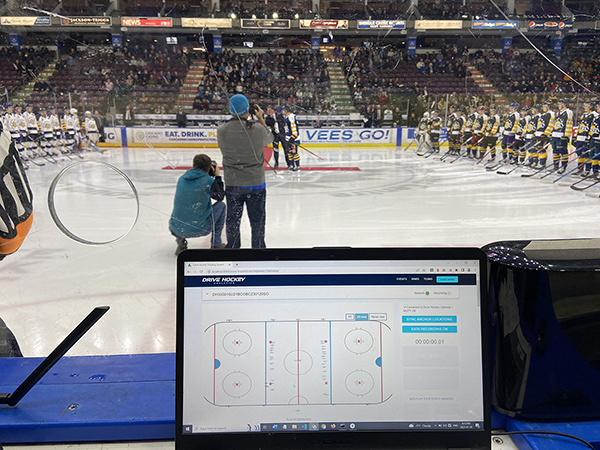
Since launching in 2018, Drive Hockey Analytics helps young hockey players improve their performance on the ice. By quantifying players’ speed, acceleration, shifts, turns, and more—the platform provides insights that benefit players, parents, coaches, and scouts. These analytics bring elite-level data to hockey players of all skill-levels.
We met with Mike Dahlstedt, Founder and CEO, earlier this month to discuss how Accelerate IP’s programming helped the company formalize its IP strategy and strengthen its competitiveness in the market.
Your elevator pitch: What problem is Drive Hockey Analytics trying to solve as a startup?
Hockey player development has always relied on gut instincts. Coaches watch, form opinions, and make calls based on what they saw and their own personal experiences—however, opinions vary. Three different people give three different opinions, and players then wonder how they can reach the next level.
Drive Hockey Analytics quantifies player performance. We’ve built patented wearable sensor technology that captures real athletic data (fitness, skill performance, tactical impact, decision making) and turns it into actionable insights. Instead of getting commentary like “you need to be better defensively”, with our technology, players can get objective metrics showing exactly where, when, and how they’re performing. Players can compare their insights to peers at their level, and help chart a path to reach their personalized goals.
We’re replacing gut instincts with data-driven development, starting with hockey.

What’s the importance of IP in your industry ?
The market demand for sports performance technology is exploding, but the industry’s ability to satisfy those demands—especially at the amateur level, is still emerging. The companies building this technology today are pioneers, investing heavily into foundations that will shape how athletes train and develop for decades.
Protecting those investments early-on is essential. The work we’re doing now to build sensor infrastructure, develop AI to harness deep data, and prove the model works, will create significant value as the market matures. Strong IP protection ensures we can realize that value, rather than watch well-resourced competitors replicate what we’ve built.
In an emerging market, the pioneers who protect their innovations are the ones who benefit when the market fully matures.
What impact did the AccelerateIP program have on your business?
AccelerateIP gave us a deeper understanding of the value, process, and strategy around protecting our intellectual property. Before the program, we knew we had valuable IP, but hadn’t fully connected it to our broader business trajectory.
The program helped us see IP not as a one-time filing exercise, but as an ongoing strategic asset. We came away with clearer frameworks for evaluating what to protect, when and how to do that, and how to leverage our IP position to strengthen conversations with partners and investors.

Any words of advice for other founders on their IP journey?
One mindset shift that helped me is thinking of IP like having chips in your hand. They become important when you’re negotiating—whether with investors, distributors, potential acquirers, or larger industry players.
A reality I’ve seen often is if you’re building a business in an active space, the chances you’re infringing on a bigger competitor’s innovations are high. As you grow, if you don’t have any cards in your hand, then you’re not in a good position to negotiate, compete, or collaborate with them. Having IP establishes tangible value that can give you something to lean on and bring to the table.
Your IP strategy should align to your business strategy; they go hand-in-hand. If you’re investing into R&D, product, and market development—you should also be investing into protecting your IP. The innovations you’re building today need protection to deliver value tomorrow. If you’re not protecting your own IP, you’re leaving your core business value exposed to competition.
IP planning should be part of your regular workflow when reviewing new features, new markets, sales, and distribution strategies. Consider establishing an IP board to help plan and prioritize. Get your teams familiar with it, and make it part of your business culture. I would also suggest getting to know some professionals who can support you as needs arise.
Looking to apply for funding supports with AccelerateIP?
Applications for Stream 2-2 and Stream 3 open Thursday, May 14 and close Monday, June 15, 2026.
Learn more or apply on the Program Portal.